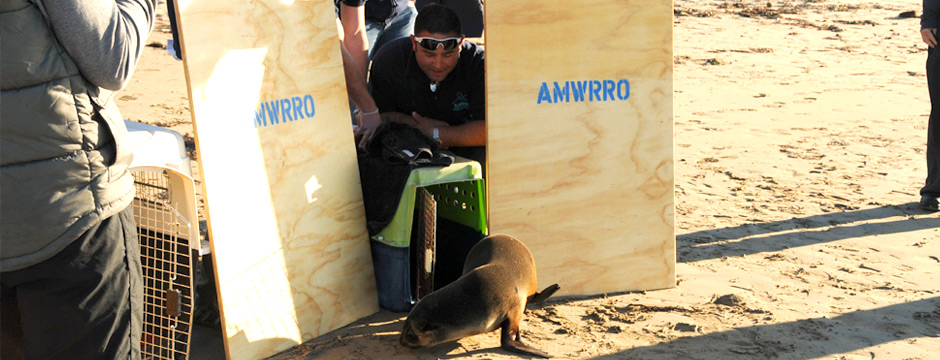
Rescue

Rescue

Rehabilitate

Rehabilitate

Research

Research

Release

Release

Australian Marine Wildlife Research & Rescue Organisation – AMWRRO

Australian Marine Wildlife Research & Rescue Organisation (AMWRRO), providing a rescue and rehabilitation service for our incredibly unique Australian marine wildlife species.

Found an injured marine animal?

Great Cormorant receives lifesaving surgery

The story about “Billy Bunter” a very lucky juvenile Great Cormorant that survived a lifesaving surgery in order to remove two hooks, swivel and line form his stomach. Long time AMWRRO volunteer Malcolm and newly joined member of our team Danielle rescued the bird from Garden Island on the 24th January after a member of the public found the bird to have line coming out of its mouth.

On arrival the bird did not have line coming out of its mouth but after a full assessment which included radiographs; it was soon discovered that surgery was the only option for this youngster in order to survive.

Dr. Lisa Treatch C/- The Adelaide University – Roseworthy Veterinary Department agreed the animal required surgery in order to survive and kindly performed the surgery yesterday (26th January).  As tricky as surgeries are, bird surgeries (in particular deep diving birds such as cormorants) are extremely tricky as these animals can often die whilst under anaesthetic due to their dive response and their ability to hold their breath for long periods of time.

Fortunately for Billy Bunter the surgery was a great success and now this young bird is on the road to recovery. The surgery lasted 42 minutes and was assisted by AMWRRO volunteer Sarah whilst the entire operation was performed under the watchful eye of President Aaron Machado.

Billy Bunter is expected to remain in intensive care for the next 96 hours before being allowed to swim and stay out doors in the confined cages which overlook the main wetland facility – flippers crossed he will be flying and diving again within a few weeks and released shortly thereafter.

Special thanks to Malcolm and Danielle for rescuing this young bird, to Dr. Lisa Treatch for performing such a fantastice surgery and Sarah for her assistance on the day – what a great team and congratulations to you all for a great job well done (once again!!!)

Please share this article:

Now 62 dead seals found in region!

A shocking discovery along beaches surrounding Port Lincoln on Sunday the 15th January 2012.

Initial reports of 14 dead seal pups on Sunday soon grew into a staggering 51 pups, 1 sub adult and 1 adult New Zealand fur seal on a single beach.

Monday the 16th January 2012, the number had grown yet again to 60 in total for the region with Coffin Bay beaches now also confirmed to be littered with the tiny bodies.

Tuesday the 17th January 2012, the number grew again to 62, one of which is considered new born due to its size (approximately 40cm in length)

AMWRRO members departed Adelaide at 3am on Monday the 16th and arrived in Port Lincoln at 09:30 and met with John (the Port Lincoln local who discovered the pups late Sunday afternoon and who notified AMWRRO), directions were given and AMWRRO arrived shortly thereafter.

Once on site, National Parks rangers coincidentally were conducting a bird survey on the same beach and offered to assist if needed.  In total 62 New Zealand fur seals were found (59 pups, 1 new born, 1 sub adult and 1 adult).  The state of decomposition was extreme hence only a few could be collected for post mortem examination.

The AMWRRO crew left Port Lincoln at 3pm and arrived back in Adelaide at 11:55pm.

The 17th January 2012, Dr. Lucy Woolford (a member of the AMWRRO Scientific Board) and a Lecturer at The University of Adelaide’s Roseworthy Campus (Veterinary Diagnostic Department) who assisted with collecting data on site – conducted the post mortem examinations and sent a series of tissue samples off for testing. Unfortunately due to the state of decomposition; the probability of finding a definitive cause of death is slim but we will do our best and bring any information forward to the corresponding authorities.

These pups were approximately 4-8 weeks of age and most probably from the nearby breeding colonies of Neptune and or Liguanea Islands. AMWRRO suspects there are at least double or triple that number dead but unaccounted for due to the geographical limitations of searching the nearby beaches without the help from National Parks.

AMWRRO is appealing to the general public to contact AMWRRO immediately on 08 8262 5452 whenever a sick or injured marine animal is found.

AMWRRO is a non-profit organisation that is dedicated to the care and conservation of our marine wildlife and environment and gratefully receives support and much needed funds through donations and memberships so that we can continue conducting out important work within the community; for more information or to donate please click here.


Please share this article:

14 dead seals & 1 pup still alive on small beach

Today (15th Jan 2012)  AMWRRO received information and photographs concerning 14 dead juvenile seals and 1 other still alive found amongst the dead on a small stretch of beach on the west coast of South Australia.  A team of AMWRRO volunteers and members of the AMWRRO Scientific Board are leaving AMWRRO at 3am tomorrow to investigate and collect these animals for further post mortem examinations and to attempt to save the last seal pup (photo below).

A man and his son where heading to the popular fishing beach when they made the grim discovery and only managed to check approximately 500m of the beach; there are several small coves and other beaches close by that could reveal more dead animals.

Considering the geographical location of these animals; this could well be linked to “fishing bycatch” and or be associated to malicious activities e.g. shot, stabbed and or poisoned. More information will be provided in due time and flippers crossed we are able to save the poor soul awaiting help in and amongst the dead.

Please share this article: